Introduction
Donor management is the ongoing work of understanding, serving, and strengthening the relationships that make a nonprofit’s mission possible. This guide explains the practical decisions, workflows, and habits that help nonprofit teams use technology without losing the human relationships at the center of their work.
Donor Management Is More Than Recording Gifts
A donation transaction answers only a few questions: who gave, how much, and when. Effective donor management adds the context needed to build a relationship. It helps the organization understand why someone became involved, what they care about, how they prefer to communicate, and what experiences have shaped their connection to the mission.
This work includes accurate records, timely acknowledgment, meaningful communication, segmentation, stewardship, retention, privacy, and reporting. The purpose is not to send more messages. It is to make each interaction more relevant and respectful.
Build a Complete Donor Record
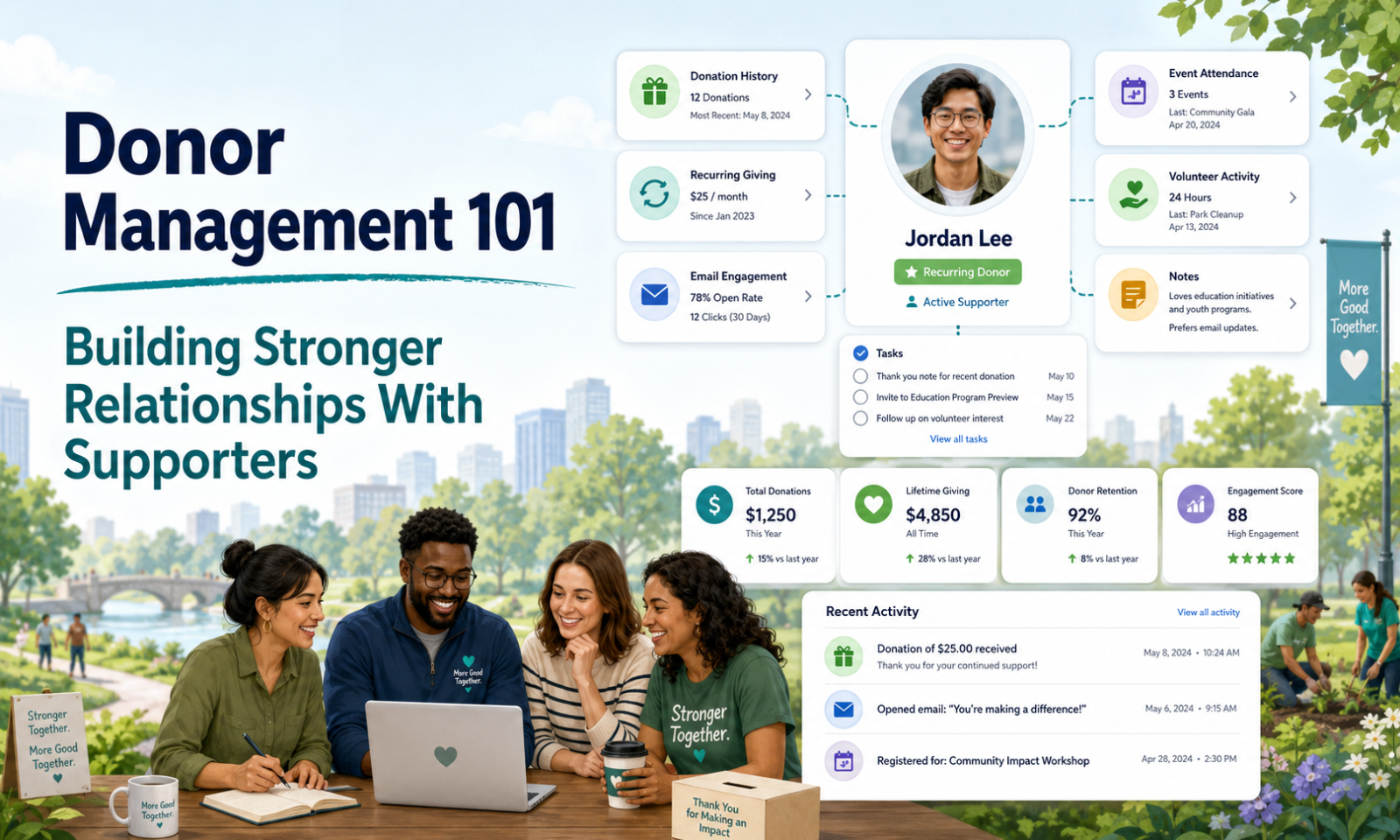
A useful donor profile includes contact information, household or company relationships, donation history, recurring gift status, campaign attribution, event attendance, volunteer activity, communication preferences, notes, tasks, and important acknowledgments.
Avoid storing critical relationship knowledge only in email or with one fundraiser. Document meaningful conversations and next steps in a shared system while respecting privacy and limiting sensitive information to those who need it.
Consistent data standards matter. Decide how names, addresses, communication consent, households, organizations, and constituent types will be entered. Clear standards reduce duplicates and make reports more reliable.
Acknowledge Every Gift Promptly
The first response after a donation sets the tone for the relationship. Donors should receive a clear confirmation and, when applicable, the information needed for tax purposes. Beyond the receipt, a sincere thank-you should connect the gift to the mission.
Automation can deliver the immediate acknowledgment, but it should not eliminate human contact. Larger, first-time, unusual, or personally significant gifts may deserve a phone call or tailored message from a staff member, board member, or program leader.
Create standards for response time, message ownership, and escalation. This prevents important gifts from receiving only a generic system email.
Segment Donors Thoughtfully
Segmentation means grouping supporters based on useful similarities so communication can be more relevant. Common segments include first-time donors, recurring donors, lapsed donors, event donors, volunteers who donate, program alumni, major-gift prospects, and donors interested in a particular cause.
Good segmentation is based on purpose. Before creating a group, ask what experience or action will be different for those people. Too many unused segments make the database harder to maintain.
Avoid treating giving amount as the only measure of value. A modest recurring donor, long-term volunteer, community advocate, or well-connected partner may have a deep relationship with the organization.
Design a Donor Journey
A donor journey maps the experience from first awareness through long-term engagement. It might include discovering the organization, making a first gift, receiving a welcome series, seeing evidence of impact, attending an event, giving again, becoming a recurring supporter, or introducing others to the mission.
Map the communications and internal tasks connected to each stage. A first-time donor may receive a thank-you, a short mission introduction, an impact story, and a gentle invitation to stay involved. A recurring donor may receive periodic updates, anniversary recognition, and advance notice of important initiatives.
The journey should feel helpful rather than automated for its own sake. Give people choices and respect communication frequency.
Practice Meaningful Stewardship
Stewardship is how an organization demonstrates that a donor’s trust was well placed. It includes reporting impact, showing appreciation, being transparent, and keeping supporters connected to the work their gifts make possible.
Strong stewardship uses specific examples. Instead of saying a campaign was successful, explain what changed: meals delivered, students supported, counseling sessions provided, animals cared for, or community spaces improved. When privacy permits, stories and firsthand voices can make the impact easier to understand.
Stewardship is not limited to an annual report. Smaller updates throughout the year create continuity and reduce the feeling that the organization communicates only when asking for money.
Improve Donor Retention
Acquiring a donor requires attention and expense. Retention improves when the organization delivers a consistent experience after the first gift.
Track whether first-time donors receive a proper welcome, how quickly gifts are acknowledged, whether recurring payments fail, which communications people engage with, and how long it has been since the last meaningful interaction.
Create specific processes for first-to-second gift conversion, recurring-donor care, payment recovery, lapsed-donor outreach, and major-donor follow-up. Retention is usually the result of many small practices performed consistently.
Use Communication Preferences and Consent
Record whether a supporter wants email, SMS, postal mail, or phone communication and which topics interest them. Honor unsubscribe requests promptly and separate administrative messages, such as receipts, from promotional communication when appropriate.
A respectful preference center can let supporters choose newsletters, program updates, event notices, advocacy alerts, or fundraising appeals. This improves relevance and reduces blanket communication.
Measure What Matters
Useful donor-management metrics include donor retention, first-time donor conversion, recurring giving, average gift, gift frequency, lapsed donors, campaign performance, acknowledgment time, and donor engagement across events, volunteering, and communication.
Numbers need interpretation. A decline in average gift may be acceptable if a campaign attracted many new grassroots supporters. A high email open rate may not matter if donors are not receiving meaningful stewardship. Combine quantitative data with staff observations and donor feedback.
Create a Sustainable Team Process
Donor management should not depend entirely on one fundraiser. Define responsibilities for data entry, acknowledgments, portfolio management, communication, reporting, and data quality.
Use shared tasks and documented workflows. Schedule regular data reviews to merge duplicates, correct returned mail, update preferences, and close incomplete follow-ups. A clean database is the result of routine care, not a one-time cleanup.
How More Good Together Supports Donor Management
More Good Together is designed to connect donor profiles with donations, campaigns, events, volunteer activity, programs, communication, tasks, files, and reporting. This broader view helps teams understand that supporters often contribute in more than one way.
The platform’s goal is to reduce fragmented records and make donor acknowledgment, segmentation, follow-up, recurring giving, and reporting easier for growing nonprofit teams.
Final Thoughts
The right approach should reduce administrative friction, improve the quality of information, and help staff respond more thoughtfully to the people connected to the mission. Technology creates the most value when it supports clear processes, shared responsibility, respectful communication, and better decisions—not when it simply adds another place to enter data.
Frequently Asked Questions
What is donor management?
Donor management is the process of organizing donor information and building relationships through acknowledgment, communication, stewardship, segmentation, retention, and reporting.
What information should be stored in a donor profile?
Store accurate contact details, giving history, communication preferences, relationships, event and volunteer activity, relevant notes, and assigned follow-ups.
How often should a nonprofit contact donors?
There is no universal frequency. Communication should be consistent, relevant, and based on donor preferences rather than driven only by fundraising asks.
What is donor stewardship?
Stewardship is the ongoing practice of thanking donors, reporting impact, maintaining trust, and demonstrating responsible use of their support.
Can automation improve donor management?
Yes. It can handle immediate acknowledgments, reminders, segmentation, and routine follow-ups, while staff focus on personal relationship-building.